Every chemical product needs two things: a feedstock and energy. At Cyclize, the feedstock is hard-to-recycle waste and the energy is electricity, delivered to the process via plasma. Together with Siemens, we have developed a modular power system that converts grid energy into plasma power with world-leading efficiency, built to the standards of the chemical industry.
Power Systems for Resilient Chemical Value Chains
Carbon-based chemical production rests on two fundamental inputs: a carbon feedstock and energy. The energy is needed to break existing chemical bonds and to drive endothermic conversion steps, such as reforming a feedstock into syngas. Today, both inputs are largely fossil. Crude oil and natural gas provide the feedstock. The process heat typically comes from burning fossil fuels or from partially oxidizing the feedstock itself.
Cyclize replaces both. Our feedstock is waste that cannot be mechanically recycled, and our energy source is electricity. Plasma delivers this energy directly into the process. No part of the feedstock has to be oxidized to supply heat, so more of its carbon remains available for new products.
This moves a central question from chemistry to electrical engineering: how do you turn grid power into plasma power efficiently, reliably and at industrial scale? Together with Siemens, we have developed an answer.
From Grid Power to Plasma Power
Our power chain consists of three stages, each designed for efficiency and scalability:
- Grid connection: A line-commutated rectifier from Siemens converts alternating current from the grid into direct current. The technology scales up to 100 MW and combines extremely high efficiency with low electromagnetic interference (EMI).
- 800 V DC bus: An 800 V DC bus distributes the power to the drivers with minimal losses, following the same principle used in state-of-the-art EV charging infrastructure.
- Modular plasma drivers: Cyclize's in-house plasma drivers convert the bus power into the high-voltage supply that the arc plasma requires.
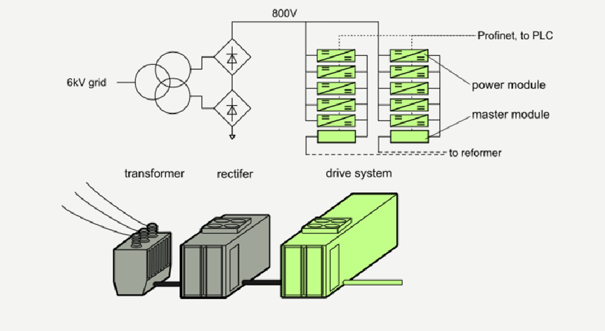
The roles are clearly divided. Siemens is responsible for the grid side, including power supply stability and conformity with grid codes and regulations. Cyclize develops the plasma side, which is the core of the process.
Partnering with Siemens: Proven Technology on the Grid Side
For a technology that aims to enter the ChemPark, there is no place for experiments.Siemens has been building electrical infrastructure for industry for more than175 years, and its products have proven themselves in the most demanding environments worldwide. What made the collaboration exceptional is that Siemens combines this robustness with a genuine drive for innovation. Instead of creating a one-off special solution, Siemens engineers developed the application on the basis of their standard equipment. For Cyclize, this means:
- Industry-proven components: Field-tested products provide the reliability that operators in the chemical industry expect.
- Regulatory certainty: An experienced partner takes care of grid stability and regulatory conformity.
- Scalability: Because the solution is based on the Siemens standard portfolio, it grows with us from lab plants over our industrial first of its kind plant (FOAK) until our next of its kind plants (NOAK).
This allows us to focus our development capacity on our core expertise: the plasma side.
Why We Develop Our Own Plasma Drivers
We develop both the power modules and the master module in-house, for three reasons:
- No suitable product exists: The market offers no power supplies compatible with high-voltage arc plasma that fulfil the requirements of our application.
- Plasma and power electronics must be designed together: The interaction between plasma and driver is so close that a favorable result requires both disciplines to work hand in hand, within one team.
- Cost is decisive at scale: The drive system is a major factor in overall system cost. The closest related products come from medical devices, R&D and semiconductor manufacturing, where precision is key and cost and efficiency are secondary. Large-scale chemistry needs the opposite. In-house development and our own series production line make our drivers highly cost-effective. Their modularity lets us adapt them to every stage, from the laboratory to world scale.
The result is best-in-class efficiency across a wide range of load conditions and superior power density compared to industrially available power supplies.
Validated in Full-System Operation
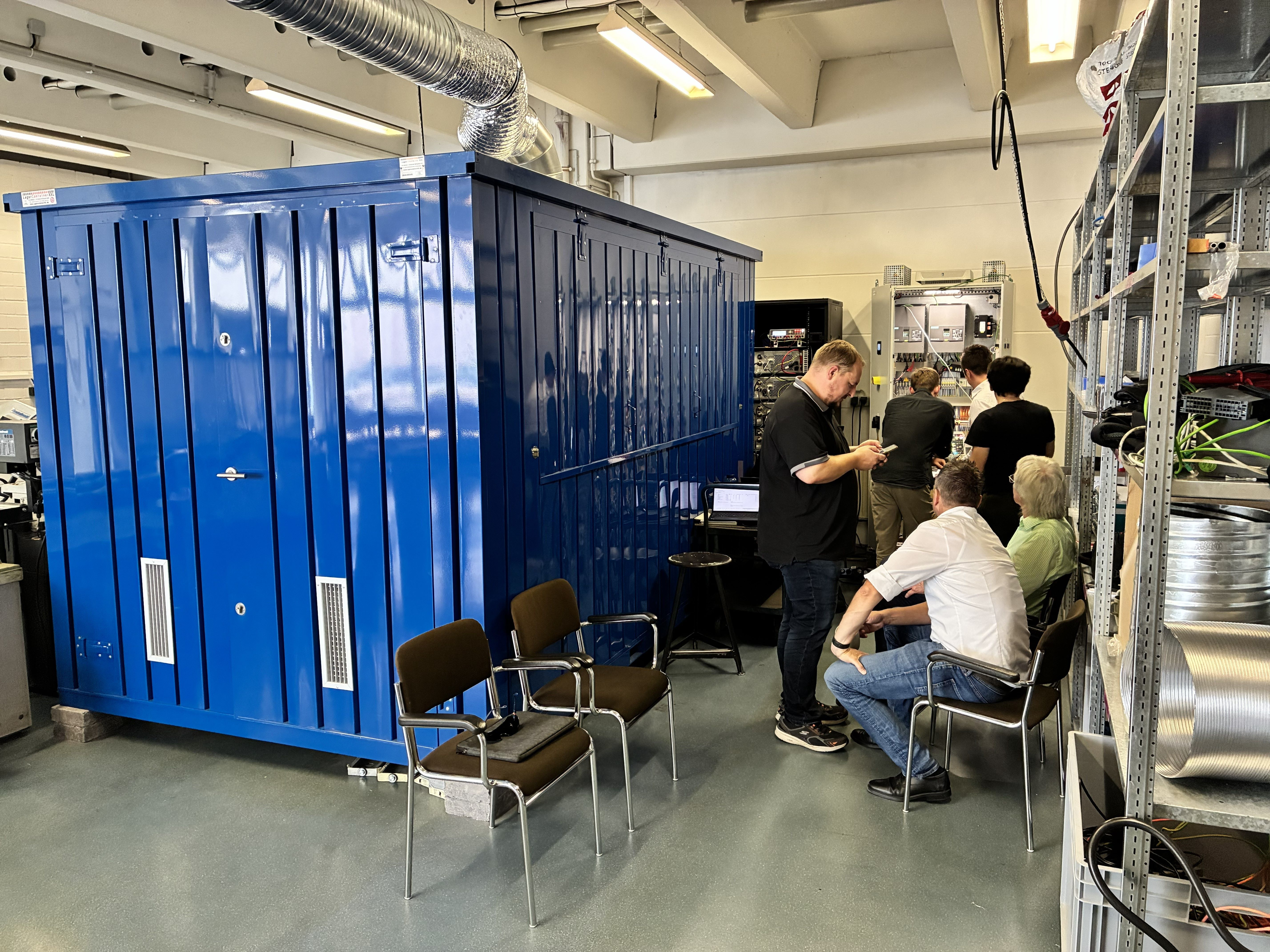
Together with Siemens and with support from Hochstrom GmbH, we built a demonstrator that runs the complete power chain under real operating conditions. The key results so far:
- Full system in the target topology: Rectifier, DC bus and drivers are arranged in the modular topology designed for MW-scale plants. Every unit in the demonstrator is a building block of that architecture.
- Ignited plasma in standard operation: The system runs with a stable arc plasma, not a resistive dummy load.
- Load changes and emergency shutdown: Dynamic operation and safety functions have been successfully demonstrated.
- 98% driver efficiency: Electricity is our main energy input, so every percentage point of efficiency directly reduces OPEX.
- 3,000+ hours of combined operation: Our drivers have already proven their robustness in continuous use.

To Put it Simply
Plasma reforming can only be as good as the power that drives it. By combining industry-proven grid technology from Siemens with our highly efficient, modular plasma drivers, we have developed a power system that meets both requirements of the chemical industry: innovation and reliability. The technology is ready for the next step: industrial application.